 Go back
Cargo shipping in Russia: where are we going?
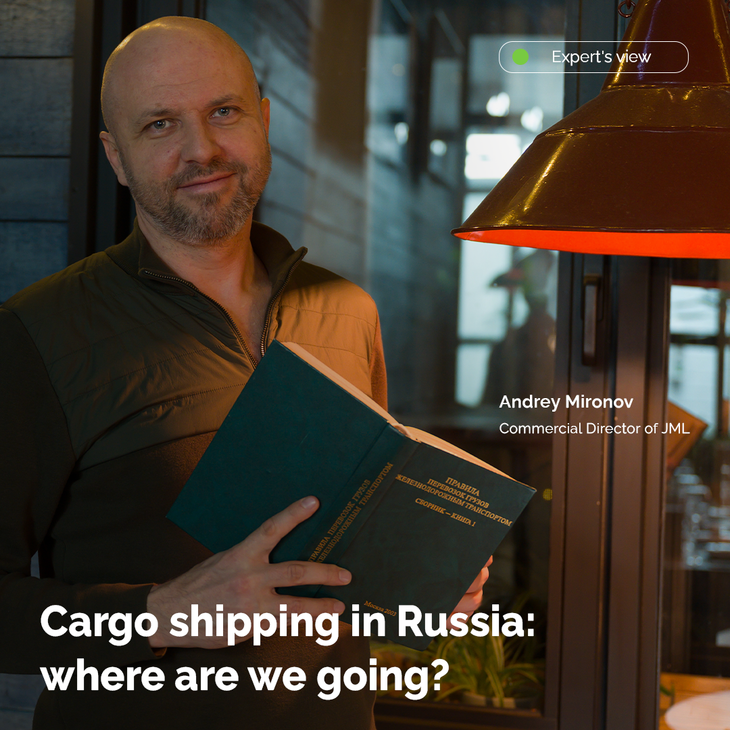
We talked to JML Commercial Director Andrei Mironov about the current situation with Russian cargo transportation.
What is happening now in the transportation sector in Russia? What has changed over the last 2-3 months?
There are changes, of course. But let's talk about everything in order. In March and April, many colleagues were saying that things were bad... There are no reliable cargo delivery routes. There is no possibility to bring, export, customs clearance, etc. Now, talking to the same people, I hear that the situation has improved. New ways of delivery, new (or well forgotten old) channels of shipments have been found. Everything is working more or less normally. Delivery times have become more clear and predictable. Prices are starting to come down. Sanctioned carriers are leaving, and new players are taking their place. New companies are greedy for results! New players are ready to provide more interesting prices and quality service, with a plan for future work. New carriers, due to their mobility and flexibility, quickly gain the necessary volumes and deliver goods faster.
Do you think the current situation can be called stabilization or positive dynamics?
Today, the logistics industry is in a period of adaptation. Another peak load has passed. A more understandable phase is coming. But, as practice shows, the next spiral may not be easier than the previous one... Today, logistics is adjusting to the current, changing conditions. I hope that preventive measures will be introduced to normalize the situation in the future. But we will talk about that a little later. Today, we cannot influence the transportation process in a qualitative way. We work with what we are given. Companies do not work out new logistics schemes, do not think about new supply chains. It is clear to everyone that we are in an unhealthy, poorly competitive environment. Transportation is unstable, and this cannot be called a positive trend. On the contrary: we are undergoing a constant, unceasing test of strength, flexibility and adaptability. Yes, people are starting to speak calmly about the current circumstances; you also get used to bad things ... Some say that the situation has normalized. But if we look at the figures, we will not see any positive dynamics. If you look at the statistics of recent months, it is obvious that imports, exports and transit have sagged by 20-50%. Intra-Russian transportation has fallen by 8-13%. The measures that are being taken to stabilize the situation are designed for the long term. Now we are rolling in “neutral” and it is unclear how long the inertia will last. I do not think it is good.
In your opinion, what should we expect in the near future?
We are in a period of transition. Most of the sales markets are closing, consumer power is falling due to rising prices and low wages. But we are searching for new contractors and renegotiating contracts. This process will take time. The process of “raising the heads” of consumers will take even longer. Right now, many people are thinking about how to make ends meet rather than alternative purchases. Based on this data, I think that transportation volumes will fall.
When will they recover?
If the world agreements are not directed towards normalization of relations between the countries, it is hardly worth waiting for positive dynamics. Moscow, Khabarovsk, Novosibirsk, Vladivostok, etc., China... Everywhere there is a decline in loading and unloading. This trend will continue at least until the end of the year. This means that carriers will fight for customers. And prices will continue to fall, so we should expect dumping. As for the shortage of containers, it will remain, but it will manifest itself to a lesser extent than before (rather, in a wave-like manner). Besides, analyzing the news agenda, we can predict another wave of crisis. Therefore, it makes sense to prepare to resist provocations, negative information pressure, to train internal stability and, in general, to gather strength. Communication, interaction with people close in spirit and spirit, with colleagues and friends, as well as the exchange of factual information and experience can help.
What are JML's current advantages?
Today, as always, JML delivers our clients' cargoes in full. The company works out alternative routes and is flexible in its pricing policy. Volumes have slightly decreased, but we are constantly looking for new destinations. JML maintains the set course of development despite changing and ambiguous conditions. The fact that we do not use borrowed funds helps us to maintain stability. And we can guarantee our clients greater stability and security, as we do not depend on changes in the banking system (rates, sanctions, etc.).