 Go back
Russian logistics

Major players are leaving the Russian market: Hapag Lloyd, Maersk, DHL and others. At the same time, they declare a financial recovery in their companies and declare an increase in profits. However, we see that the overall cargo traffic is not growing, but even decreasing.

Now transportation volumes have fallen by times: where 8-10 trains used to be dispatched, now it is 2-3 trains; where 500-600 containers were handled per month, now it is 200-300. Delivery times have increased and the number of “abandoned” trains has increased. Let's look into what is the reason?

Today's news selection is not limited directly to the logistics industry. JML Commercial Director Andrey Mironov has selected and commented on the key events taking place in the world in various spheres and directly affecting supply chains.

We analyze news from the world of logistics, make conclusions and explain what this may mean for participants in the Russian logistics market. Andrei Mironov, Commercial Director of JML, comments on today's news compilation.
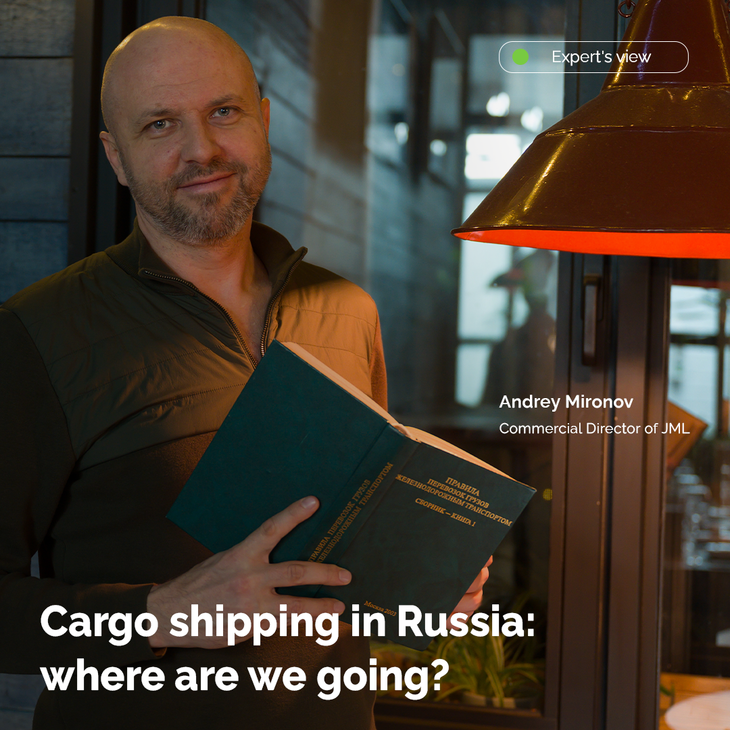
We talked to JML Commercial Director Andrei Mironov about the current situation with Russian cargo transportation.

Statistics show that from January to April 2022, the railroad transported 1985.8 thousand TEU of containerized cargo. This is 7.5% more than in the corresponding period of 2021. It should be taken into account that we are talking about the average indicator for the period, and this increase was at the expense of the first two months. In April, the volume decreased by 3.6% per day in relation to January, February 2022. Exports decreased by 7.4% or 0.3 thousand TEU/d, while transit decreased by 28.8% or 0.8 thousand TEU/d. Obviously, the negative dynamics will continue.

Currently, we observe that all cargo terminals around Moscow are overflowing with empty containers. And this is against the background of a shortage of container equipment. What kind of shortage are we talking about?

More and more foreign companies are announcing their withdrawal from the Russian market or suspension of operations in Russia. Yes, this changes well-established supply chains and logistical links. But “no place is empty”, especially when it comes to vacated market niches.

In 2021, 6.5 million TEU of freight was transported by Russian railroads. This is 12.1% more than in the previous year. And this is an absolute record! The most active-ly growing segment is accelerated contain-er trains. Over the past year, 35 thousand RCTs were dispatched and more than 1,000 destinations were involved. More than in the entire history of these ship-ments.

— What are the reasons for today's difficulties related to transportation? Can we now talk about a crisis in the logistics industry?